Read the warranty documentation before you do anything

This sounds obvious, but most homeowners skip it and go straight to whatever cleaning method they've used before. Composite decking warranties vary significantly by manufacturer, and the cleaning requirements are specific enough that assumptions from one brand don't always transfer to another.

Trex, which is one of the most widely installed composite decking brands, explicitly allows pressure washing at up to 3,100 PSI with a fan tip — considerably more aggressive than what most wood decks tolerate. TimberTech and Azek products have their own specifications, and some of the capped composite products on the market recommend staying below 1,500 PSI to avoid surface damage to the protective cap layer. Fiberon has similar guidance with brand-specific caveats.

The warranty documentation for most major composite brands is available on the manufacturer's website, and the maintenance section is usually only a page or two. Finding the specific PSI limit, tip recommendation, and any approved cleaning products for your brand takes about ten minutes and is the single most valuable thing you can do before starting. Cleaning your deck in a way that contradicts the manufacturer's documented guidelines is how warranty claims get denied — even if the damage looks unrelated to the cleaning method.


estimated_quoteArtboard 3

Get a Free Quote

Contact Us

Everything You Need to Know Before Pressure Washing Your Deck

Technique matters as much as pressure

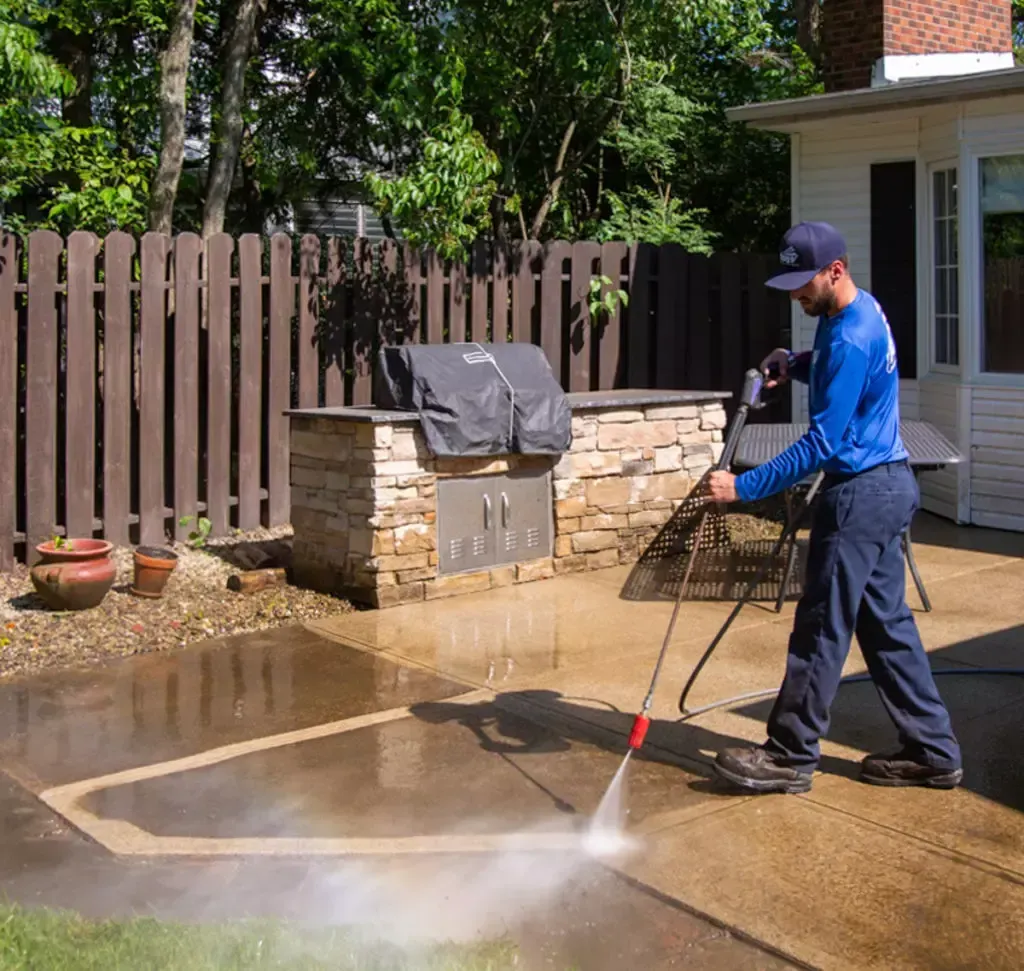
Even within the PSI limits the manufacturer allows, technique determines whether you end up with a clean deck or a damaged one. The most important rule is to keep the wand moving continuously and maintain a consistent distance — typically eight to twelve inches from the surface for composite, slightly farther if you're at the upper end of the allowed PSI range.

Always work in the direction of the board's grain or texture pattern. Composite decking has a directional surface texture, and cleaning across it rather than with it can leave visible marks that are difficult to reverse. This is especially true for brushed or embossed finish composites where the surface texture is more pronounced.

Use a 25 or 40-degree fan tip rather than a narrow-angle tip. The wider the fan, the more the pressure is distributed across the surface rather than concentrated on a single point. A zero-degree tip has no place on composite decking — at any PSI, the concentrated stream can etch or scuff the surface in ways that are permanent.

Keep the wand moving at a pace that covers roughly one to two feet per second. Moving too slowly concentrates water in one spot; moving too quickly leaves the surface incompletely cleaned and may mean going back over sections multiple times, which adds up to more total exposure than a single careful pass.

Cleaning products and composite decking

Pressure washing a composite deck without voiding the warranty also depends on what cleaning solution, if any, you apply beforehand. Most composite manufacturers approve mild soap and water for general cleaning. Oxygen bleach solutions — OxiClean or similar — are widely approved for mildew and organic staining and are gentler on the composite surface than chlorine bleach, which some manufacturers specifically prohibit because it can discolor or degrade certain composite materials.

Avoid petroleum-based cleaners, paint thinners, or anything with abrasive particles — these are the categories that appear most commonly on manufacturer prohibited lists and that cause the kind of surface damage that voids coverage.

If your deck has specific staining — rust marks from metal furniture, grease from a grill, tannin stains from leaves sitting wet on the surface — most manufacturers have approved spot treatment recommendations in their maintenance documentation. Using an unapproved spot treatment on a visible stain and then pressure washing over it is a combination that creates risk, so check the documentation on both the cleaning product and the technique before proceeding.

Satisfied Clients

quotes2Artboard 2

Milwaukee Pressure Washing Near Me?

The broader point

The reason composite warranty language around cleaning exists is that the manufacturers have tested their products and know what causes surface damage. Working within those guidelines isn't just about protecting the warranty — it's about protecting the deck itself. Composite decking done right looks good for decades. The cleaning approach that keeps it looking that way is simpler than most people expect once they've taken the time to look it up.

Your deck brand's maintenance guide is the most reliable resource you have. Use it.